

My journey to become a Master of Whisky™
...and perhaps the first woman ever to do so?
Before I dive in, I’ll make it clear that I am no Master of Whisky™…yet.
In the interest of transparency, I’ll tell you that I only got into whisky about 4 years ago. I wrote a bit about it in this article, but suffice to say: my first experience of the stuff was horrid, which is why I was dragged to a tasting in Edinburgh on my hen do in 2021 whilst kicking kicking and screaming.
(“My memories of whisky are entirely of being sick on it in Rome when I was 21…I don’t want to go”; “We’re in Scotland, so we have to. It’s obligatory.” And off I went with a scowl…then out of the pub I came wanting more.)
Cut to late 2025: I’ve somehow made whisky my whole personality.
It might even become my whole business.
I’ve been eyeing professional certifications for a while, because I’m a sucker for a piece of paper that shows an accomplishment. (For more on my need for formal education, please see my two bachelors degrees, the Master’s, and that hard-won PhD.)
In 2024, I hopped on a train from London to Edinburgh to go through Edinburgh Whisky Academy’s Diploma in Single Malt Whisky. And it was a fantastic experience, even beyond meeting my now-mentor and co-author, Vic Cameron.
But I’ve been coveting the big boy: The Council of Whiskey Masters’ Master of Whisky qualification.
So here we go….

The Master of Whisky™ and its parts
The Council of Whiskey Masters was formed in the United States only a few years ago. The founders noticed a gap in the drinks industry: While there is a long-established culture around professional and certified wine sommeliers, there was none for whisky.
It seems that most of the members of the board are bonafide somms from the wine world, and there’s a sizeable overlap in that crew of legends in the whisky industry, including seminal whisky writer Charlie MacLean and field-guide rockstar Hans Offringa.
And so, the Council has put together an incredibly rigorous journey to take candidates from certified professional to master.
There are two tracks that lead to the top level:
Start with Level 1, where you choose to become a certified professional in bourbon or Scotch through self study and multi-choice exam.
Move on to Level 2, where you become a certified whisk(e)y specialist, encompassing all types of whisky from around the globe. This is also a self-study course that culminates with a multi-choice exam. (Psst, if you want to know why I switch between whisky, whiskey, and whisk(e)y, I explain in this article.)
Make it to the Masters level. Again, you’ll choose between bourbon and Scotch here, and you’ll spend up to a year preparing for the rigorous 4-day exams, which include blind tastings, oral theory tests, and a written theory exam. Though mostly self study with an extensive list of required reading, you also have the option to be pared with a current Master for mentorship, and you can drop into group study sessions.
The final step is Level 4: The Master of Whisk(e)y. There’s no choosing here between whisk(e)y types of regions. You’ll need to know it all—from Scotch to bourbon to Japanese blends and emerging expression from Taiwan and India, nothing is off limits. You’ll need to identify types in the blind tastings and discuss the history and science of each in the oral session.
From beginning to Level 4, you’re looking at least 2 years of dedicated study. And the Masters exams are only offered once a year.
And so I decided to partake…
As I said, I’ve made whisky my whole personality. And I adore formal recognition.
The Council had me at “diploma and pin badge.”
But this is a real commitment, and I didn’t think I’d have the time or headspace until perhaps 2027…but emails went out last week asking potential candidates to make their claims on a 2026 spot.
The email made an incredible case: we’ll set you up with a mentor, throw you into study groups…want a special retreat? We’ve got you. Oh, and did we mention that the exams take place in an actual castle, and you’ll get a fancy room to stay in?
My reckless heart jumped in.
(It’s great for content, Shell. Imagine everything you can write about on Substack from this! And you should probably start a YouTube channel while you’re at it.)
Scotch whisky is my focus for 2026 anyway as Vic and I work on our book, so this all flows nicely.
The nuts and bolts
A few days ago, I had a phone call with the founder of the Council. His focus is candidate success, so while the exams hold no punches, he’s there to ensure that we have all of the guidance we need.
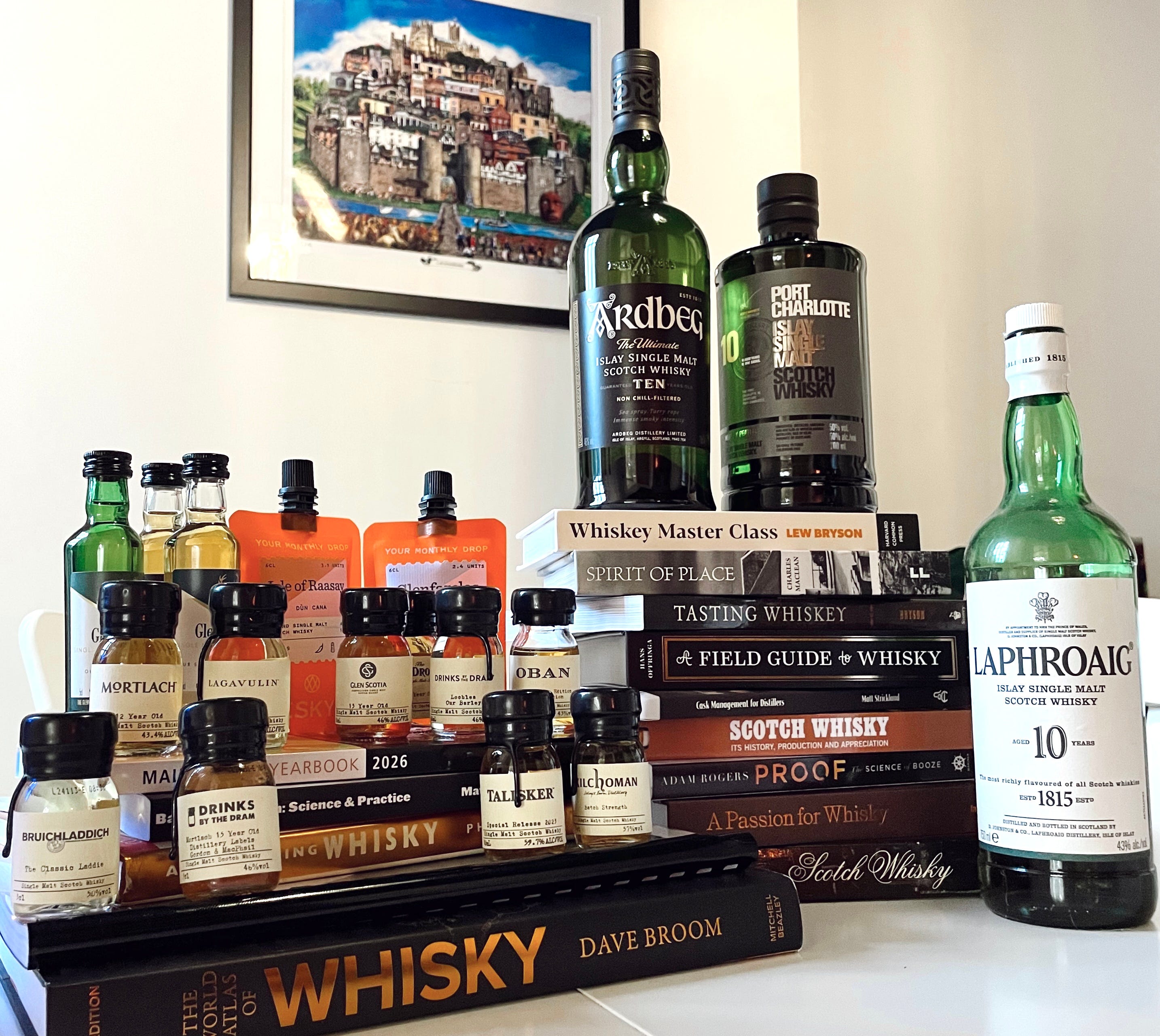
Part of that guidance was suggesting that I start to build a library of 100 Scotch whiskies.
Fantastic in theory—I’d love to line my shelves with various bottles—but prohibitively expensive in practice.
For the blind tasting, you see, you’ll need to pin point distilleries and regions. You’ll have to identify the provenance of a dram…and there are 24 distilleries on the list of possible contenders. If you were to buy perhaps the 4 core expressions from each, there’s your 100 bottles. And there’s also more than a grand out of your pocket.
After our conversation, I raided my sample stash. As it turns out, I have a good number of small bottles from the listed distilleries. Phew.
I made a tidy spreadsheet of the expressions I’ll need, and I’ll shop the sales.
But I’ll need to get studying as soon as possible to train my nose and my palate, so I scooped up my half-drunk bottle of Laphroaig 10, ordered a Port Charlotte 10 and an Ardbeg 10, and I’ll start with distinguishing peat smoke varieties.
It’s really tough research to have to sip these smokey drams, but that’s show biz, baby.
Then on to the required reading.
There are more than 10 books required on the curriculum, so of course I ordered them all toot suite. (The only thing I love more than a formal certificate is a book.)
I’ve been advised to start with process. I’ll be tested on the ins and outs of production, and I’ll be asked to troubleshoot how and why certain flavours come out due to the science and process of distillation and maturation.
Off I go…
As we go into 2026, it looks as though it truly will be my year of whisky.
There’s the book on Scotch whisky in the works, there’s chairing the King George V whisky society, and now there will be a strict regimen of study, tasting, and smell training.
Here on Substack, I’ll be creating new content around what I’m learning—both as a means to solidify my knowledge (as a former teacher, I can tell you with certainty that we learn more while teaching than from reading and self study) and as a means of sharing.
(As one of the whisky society lads to me recently when I broke the news that I’d have to build my own whisky library: “sharing is caring.”)
And beyond writing, I’ll be doing video content here as well as on a new YouTube channel, aptly titled Whisky Scholar.
To sweeten the deal, my detailed and spent-too-much-time-on-them study packs and colour-coded notecards will be made available to paid subscribers.
It’ll be a party all around. I hope you’ll join.
But will I be the first woman to become a Master of Whisk(e)y™?
It’s entirely possible.
I won’t be able to take the Master of Whisky™ exam in 2026. I’ll be in Scotland for Level 3: Master of Scotch, so I’ll need to wait a year to for the final set of exams.
But I do know that, to date, only a small handful of women have passed the Level 3 exams to become Masters of Scotch or bourbon. And that means that, if no women become Masters of Whisk(e)y™ in 2026, I could very well be the first in 2027.
I’ll keep you posted.
But I’ll tell you right now that as much as I love a certificate, a pin badge, and a stack of books…I might love even more to become the first person to do something.